


How Traffic Filtering and Cloaking Help Affiliate Marketers Improve Campaign Performance
A practical look at how traffic filtering and cloaking help affiliate marketers and media buyers manage traffic quality: GEO, device, VPN/proxy detection, real-time routing, analytics, and responsible configuration.
%22%2F%3E%3Ccircle%20cx%3D%2261%22%20cy%3D%2236%22%20r%3D%22130%22%20fill%3D%22url(%23glow)%22%2F%3E%3Ccircle%20cx%3D%22124%22%20cy%3D%22232%22%20r%3D%22110%22%20fill%3D%22url(%23glow)%22%2F%3E%3Cg%20stroke%3D%22%2338b494%22%20stroke-width%3D%221%22%20opacity%3D%220.35%22%3E%3Cline%20x1%3D%22311%22%20y1%3D%22212%22%20x2%3D%22179%22%20y2%3D%22209%22%2F%3E%3Cline%20x1%3D%22311%22%20y1%3D%22212%22%20x2%3D%22185%22%20y2%3D%22195%22%2F%3E%3Cline%20x1%3D%22294%22%20y1%3D%22116%22%20x2%3D%22179%22%20y2%3D%22209%22%2F%3E%3Cline%20x1%3D%22294%22%20y1%3D%22116%22%20x2%3D%2239%22%20y2%3D%22143%22%2F%3E%3Cline%20x1%3D%22135%22%20y1%3D%2259%22%20x2%3D%22185%22%20y2%3D%22195%22%2F%3E%3Cline%20x1%3D%22179%22%20y1%3D%22209%22%20x2%3D%22214%22%20y2%3D%22134%22%2F%3E%3C%2Fg%3E%3Cg%20fill%3D%22%2338b494%22%20opacity%3D%220.9%22%3E%3Ccircle%20cx%3D%22311%22%20cy%3D%22212%22%20r%3D%225%22%2F%3E%3Ccircle%20cx%3D%22294%22%20cy%3D%22116%22%20r%3D%226%22%2F%3E%3Ccircle%20cx%3D%22135%22%20cy%3D%2259%22%20r%3D%224%22%2F%3E%3Ccircle%20cx%3D%22179%22%20cy%3D%22209%22%20r%3D%223%22%2F%3E%3Ccircle%20cx%3D%22315%22%20cy%3D%2253%22%20r%3D%226%22%2F%3E%3Ccircle%20cx%3D%22214%22%20cy%3D%22134%22%20r%3D%226%22%2F%3E%3Ccircle%20cx%3D%2239%22%20cy%3D%22143%22%20r%3D%224%22%2F%3E%3Ccircle%20cx%3D%22185%22%20cy%3D%22195%22%20r%3D%225%22%2F%3E%3C%2Fg%3E%3C%2Fsvg%3E)
In affiliate marketing, the quality of incoming traffic can be just as important as the amount of traffic generated. A campaign may receive thousands of clicks, but if a significant part of them comes from bots, automated scanners, irrelevant audiences, VPNs, proxies, or users outside the target GEO, the campaign can quickly become inefficient.
This is where traffic filtering and cloaking technologies can become an important part of a modern traffic management strategy. Instead of treating every visitor in the same way, advertisers can analyze incoming requests and make routing decisions based on predefined criteria.
What Is Traffic Filtering?
Traffic filtering is the process of analyzing visitors before they reach a specific landing page, offer, or website. The system evaluates different parameters of each incoming request and determines whether the visitor matches the requirements of a particular campaign.
Depending on the setup, these parameters can include:
- Country or region
- Device type
- Operating system
- Browser
- IP address
- ISP
- Referrer
- VPN or proxy usage
- IPv4 or IPv6
- Previous visits and click frequency
- Custom blacklists and whitelists.
The purpose is not simply to block as much traffic as possible. Effective filtering helps advertisers distinguish between relevant users and traffic that may negatively affect campaign performance.
How Does Cloaking Work?
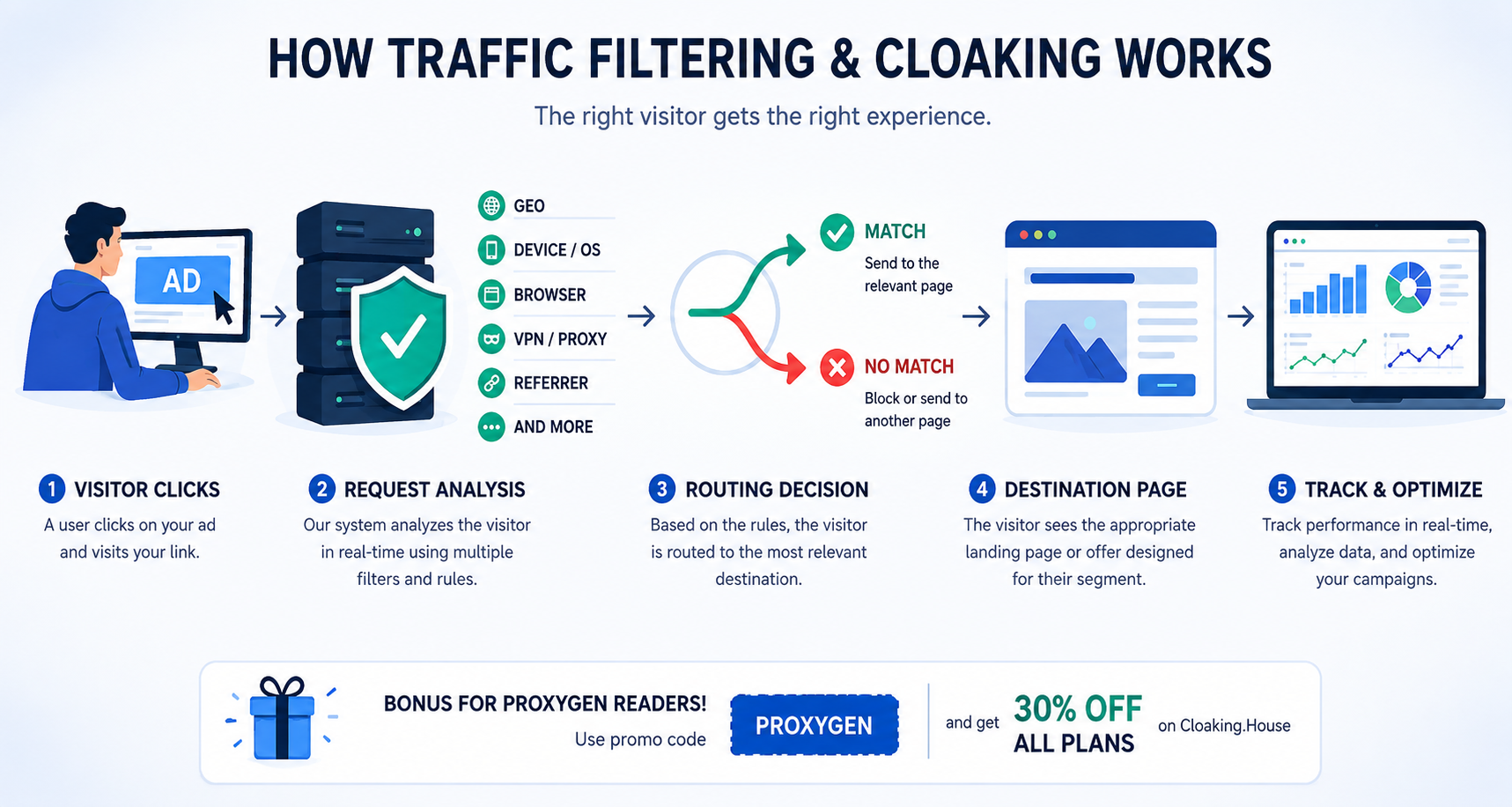
Cloaking is a traffic routing technology that uses filtering rules to determine which version of a page or destination should be presented to a visitor. In practice, an incoming request is analyzed in real time, and the system compares the visitor's parameters with the rules configured by the campaign owner.
For example, a campaign can be configured to identify traffic by GEO, device, operating system, browser, referrer, or connection type. Based on the configured conditions, the visitor can then be routed to the appropriate page or destination.
A typical cloaking setup works as a layer between the traffic source and the final destination. A visitor clicks an advertising link, the request reaches the filtering system, relevant parameters are analyzed, and the system applies the corresponding routing rule.
This approach gives media buyers more control over how different types of traffic are handled. Instead of manually creating separate processes for every traffic segment, they can manage routing conditions from a centralized interface.
Cloaking should be configured responsibly and in accordance with the policies of the advertising platform and applicable regulations. Its practical value is in organizing and controlling traffic flows rather than simply sending every visitor to the same destination.
Why Traffic Quality Matters
Affiliate campaigns are often optimized around specific audiences. For example, an advertiser may be promoting an offer exclusively to mobile users in a particular country. Traffic from desktop devices or unsupported locations may have little or no commercial value.
Sending every visitor to the same destination can therefore create unnecessary costs and distort campaign statistics.
Poor-quality traffic can affect several important metrics, including conversion rate, cost per acquisition, bounce rate, and overall return on ad spend. At the same time, automated traffic and repeated requests can make analytics less accurate and make it harder for media buyers to understand how a campaign is actually performing.
A well-configured filtering and routing system provides another layer of control between the advertising source and the final destination.
Common Traffic Filtering Parameters
One of the most useful aspects of traffic filtering is the ability to combine multiple conditions.
GEO Filtering
GEO targeting allows advertisers to define which countries, regions, or cities should be considered relevant. This is particularly useful for campaigns that work with offers available only in specific markets.
For example, if an offer is designed for users in Germany, traffic from other countries may not have the same value. A GEO filter can identify these visitors before they reach the campaign destination.
Device and Operating System
Device and OS filtering can help align traffic with the requirements of an offer. Some campaigns are designed specifically for Android or iOS users, while others may perform better on desktop devices.
Combining device, operating system, and browser parameters can provide a more precise picture of the audience.
VPN and Proxy Detection
Another common filtering layer involves identifying VPN and proxy traffic. Not every visitor using a proxy is necessarily fraudulent, but this type of traffic may require additional attention depending on the campaign.
Detecting unexpected connection types allows advertisers to make more informed routing decisions instead of relying only on IP addresses.
Referrer and User-Agent Analysis
Referrer data can provide additional context about where a visitor came from, while the User-Agent contains information about the browser and device making the request.
These parameters can be useful when investigating unusual traffic patterns or creating more specific filtering rules.
Automation Makes Filtering More Practical
Manually checking every visitor is impossible when a campaign generates thousands or millions of requests. Automated filtering systems can process traffic in real time and apply predefined rules without requiring manual intervention.
This is particularly valuable for media buyers managing multiple campaigns, GEOs, offers, and advertising accounts simultaneously.
Instead of manually analyzing every incoming request, a traffic filtering platform can evaluate the visitor against several conditions and automatically route the request according to the campaign configuration.
This approach saves time and gives advertisers greater visibility into how their traffic behaves.
Combining Filtering With Analytics
Filtering becomes even more useful when combined with detailed analytics.
Understanding why a particular visitor was filtered can help media buyers identify patterns in their traffic. Information such as IP, GEO, device, browser, ISP, referrer, and the specific filter triggered can provide valuable context for campaign optimization.
For teams running multiple traffic sources, centralized analytics can also make it easier to compare traffic quality across campaigns and identify unusual activity.
Instead of looking only at conversions, advertisers can examine the complete traffic flow and understand what happens before a conversion takes place.
Choosing a Traffic Filtering and Cloaking Platform
When selecting a traffic management solution, advertisers should consider more than the number of available filters.
Important factors include ease of integration, real-time processing, analytics, scalability, and the ability to create custom rules.
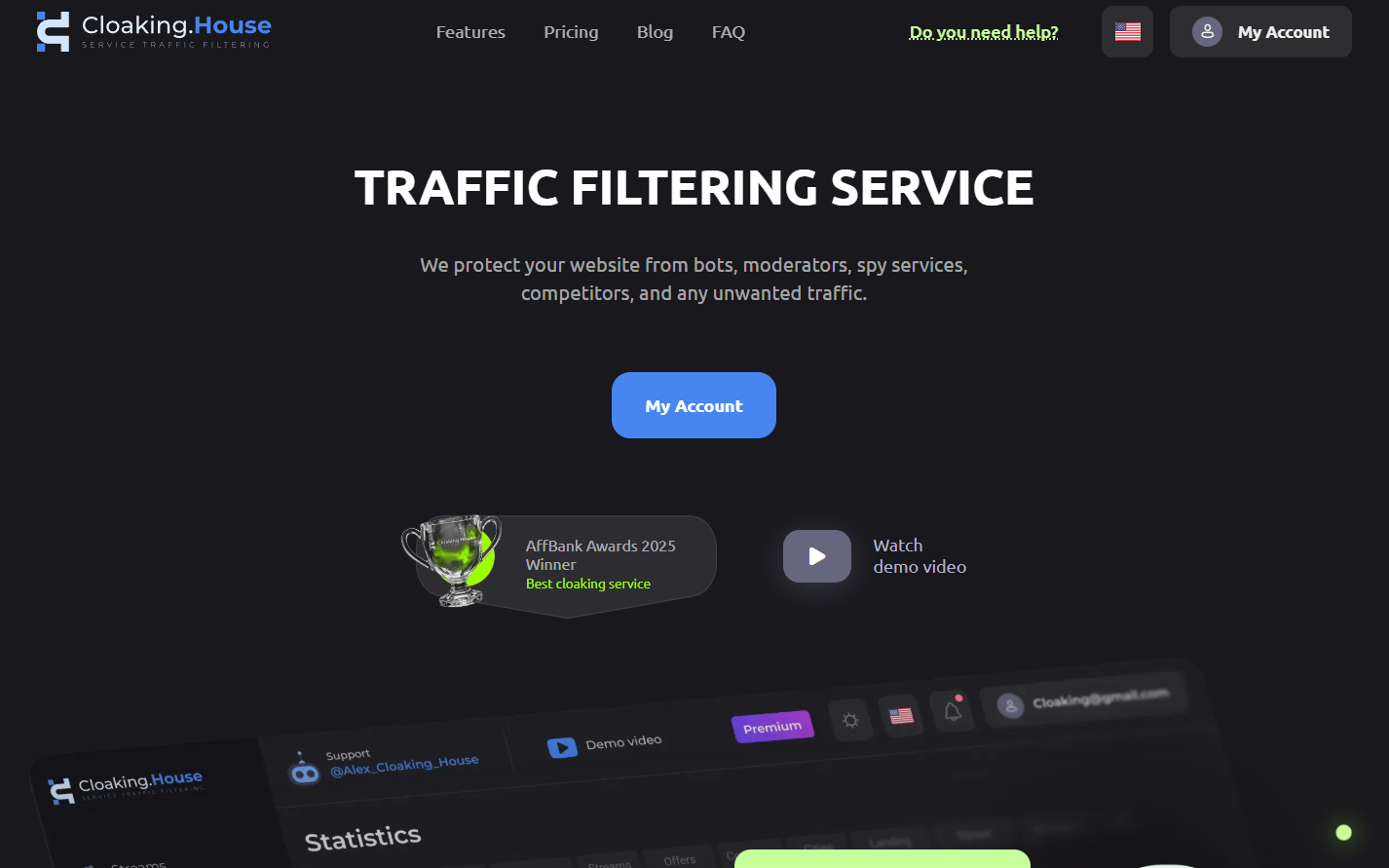
Cloud-based platforms can be particularly convenient because they reduce the need to maintain additional infrastructure. A service such as Cloaking.House combines traffic filtering, routing, and real-time click analytics, allowing media buyers to configure rules based on GEO, device, OS, browser, ISP, VPN/proxy detection, referrer, and other parameters.
The platform can work as an additional control layer between an advertising source and a campaign destination, helping teams organize traffic flows and monitor incoming clicks from a centralized environment.
Building a More Controlled Traffic Strategy
Traffic filtering and cloaking should not be viewed as replacements for campaign optimization. Instead, they can complement an existing media buying workflow.
A strong strategy starts with understanding the target audience and the requirements of the offer. From there, advertisers can create relevant filtering rules, monitor incoming traffic, analyze the results, and adjust their setup when necessary.
It is also important to test filtering configurations before scaling a campaign. Overly aggressive rules can remove legitimate users, while overly broad rules may allow irrelevant traffic through. The goal is to find the right balance between traffic quality, reach, and campaign requirements.
Final Thoughts
As digital advertising becomes more competitive, controlling the quality of incoming traffic is increasingly important. Traffic filtering and cloaking give affiliate marketers and media buying teams additional visibility and control over how different types of visitors are handled.
By combining GEO, device, browser, connection, referrer, and other signals, advertisers can build a more structured approach to traffic management. When supported by real-time analytics and automation, these technologies can also reduce manual work and make campaign data easier to understand.
Exclusive offer
Cloaking.House is giving the ProxyGen audience 30% off all plans. Enter the code at checkout.
Promo code
PROXYGEN